
Have you ever wondered why almost every medical office takes your health insurance card, but your private acupuncturist is usually out-of-network?
It is one of the most common questions in healthcare. The short answer comes down to simple math: traditional health insurance was built for high-speed volume, not dedicated one-on-one medicine.
To see why, let’s look behind the scenes at what it actually costs to care for a patient in New York City.
The Real Cost of an Hour in NYC
In a private practice, care is personal. When you book a treatment, you get a full 60 minutes behind closed doors with your practitioner. But running that private hour carries steep, ongoing costs:
- NYC Room Rent: Renting a dedicated, professional clinical treatment space across New York City generally costs around $50 per hour.
- The Session Math: When a practitioner charges $115 per follow-up treatment, subtracting that $50 room fee leaves just $65 before any other expense is counted.
- Continuous Overhead: Out of that remaining $65, the acupuncturist must continuously restock disposable medical supplies for every single visit: sterile filiform needles, herbal liniments and salves, cupping gear, moxa, massage table linens, disinfectants, and professional malpractice insurance.
- The Real Take-Home: After physical supplies, software, and self-employment taxes, the actual take-home pay is often under $50 for that full hour of clinical labor.
Now look at how in-network insurance would impact that: an insurer often reimburses only $30 to $55 total for an acupuncture visit. If an acupuncturist pays $50 an hour for room rent, taking in-network insurance would mean working for free—or literally paying out-of-pocket to treat you.
How Hospital Systems, Corporate PTs, and High-Volume Chiros Do It
Patients often ask: “How can my physical therapist or chiropractor see me on a standard copay?”
Their business models are completely different:
- One-Time Equipment vs. Constant Restocking: A chiropractic office buys drop tables once; an outpatient PT clinic buys bands, exercise weights, and treatment tables upfront. Once those capital assets are purchased, their cost per patient visit is nearly zero. They don’t have to open fresh disposable needles, hand-craft herbal formulas, or wash specialized treatment linens for every single person.
- Corporate Safety Nets: Doctors and PTs working for large hospital systems or regional chains don’t pay their own rent, front-desk staffing, or utility bills. The corporation covers overhead through high-volume billing, lab fees, and facility charges.
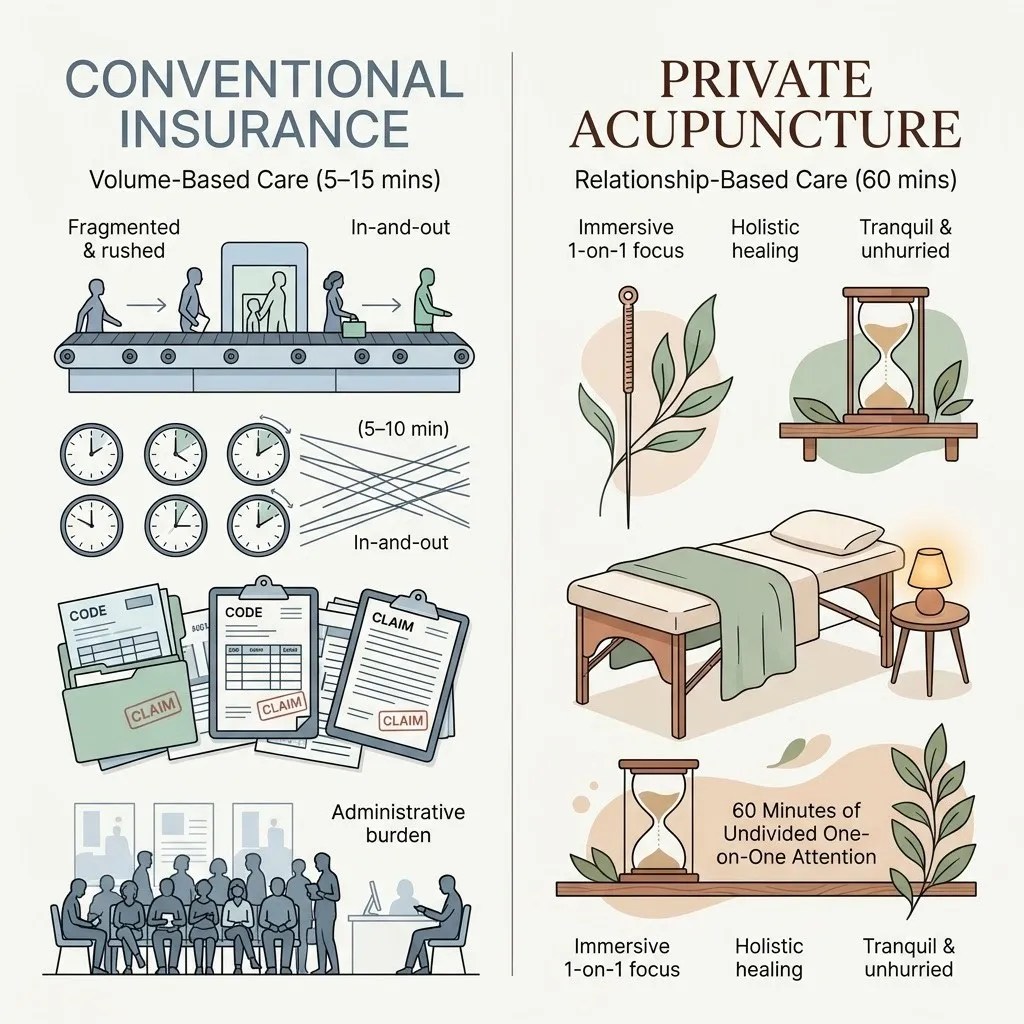
- The Assembly Line: High-volume clinics stay profitable by stacking schedules. A chiropractor spending 5 to 7 minutes on an adjustment sees 4 to 6 people an hour—generating $200 to $300 an hour. A physical therapy chain frequently puts 3 or 4 patients in an open gym simultaneously, handing people off to aides while billing insurance for each person.
To survive in-network, an acupuncturist would have to run between four curtained cubicles every hour. That model works for quick mechanical adjustments, but it destroys the somatic, restful environment needed for true nervous system regulation.
Why We Choose to Stay Out-of-Network
Choosing to stay out-of-network is an intentional decision to protect your health:
- 60 Minutes of Undivided Attention: You are never left alone in a crowded room or rushed out the door so someone else can take your table.
- Treating Root Causes, Not Just Approved Codes: Insurance usually only approves acupuncture for chronic lower back pain or post-chemotherapy nausea. They routinely deny claims for stress, hormonal balance, insomnia, headaches, and gut health. Staying out-of-network means treating your whole body without an adjuster’s permission.
- No Arbitrary Visit Cutoffs: Insurers often cap treatments at 8 to 12 visits, demanding proof of worsening symptoms to approve more. Your body heals on its own timeline, not a quarterly insurance quota.
How You Can Still Use Your Benefits
You don’t have to leave your benefits on the table:
- HSA & FSA Cards: You can use pre-tax health funds directly to cover your appointments.
- Superbills: At each visit, we can provide an itemized medical receipt (a Superbill) complete with diagnosis and CPT codes. You can submit this directly to your insurer for out-of-network reimbursement.
You deserve more than five hurried minutes in a noisy gym. You deserve an unhurried, private hour dedicated solely to restoring your balance.
Warmly,
Dr. Mary Elizabeth Micari, DAc, LAc
M Center Acupuncture and Wellness


Leave a Reply